Showing posts with label General. Show all posts

Monday, August 7, 2017

Top 10 Countries with the Safest Roads

Across the world, someone is killed on the roads once every 30 seconds. And for every death, there are at least 20 injuries every 30 seconds. According to statistics from the World Health Organization, pedestrians and drivers are much more likely to die on roads in poorer countries. Approximately 752 pedestrians die on the road every day, and 786 motorcyclists die every day in accidents globally.

Statistics from the World Bank group, Transportation for Development, are alarming, too. Less developed countries have a higher number of road fatalities, which is largely due to poor infrastructure, worse vehicle safety standards, and inadequate driving laws. The cheapest vehicles sold in first-world countries are also much safer than those sold in developing countries, due to varying safety standards.

Here’s a list of the top 10 safest countries to drive in based on the WHO Global Status Report on Road Safety interactive map. We hope India will make it to the list very soon!

10. Norway

Norway is 10th on the list with 3.8 deaths per 100,000 people. According to the WHO estimates, there were 192 total road deaths in Norway throughout 2015. The WHO deems Norway’s helmet laws inadequate, as well.

9. Spain

Spain lands in the No. 9 spot with 3.7 deaths per 100,000 people. The WHO estimates report 1,730 total road deaths in Spain throughout 2015. The WHO deems Spain’s drunk driving laws inadequate, according to the report.

8. Singapore/Israel

Singapore and Israel tie for No. 8 on the list. Singapore estimates indicated 3.6 road deaths per 100,000 people, according to the WHO. Israel also reported 3.6 road deaths per 100,000 people. The report indicates 197 estimated total road deaths throughout 2015. The WHO report also deemed Singapore’s drunk driving, speed, and child seat laws inadequate.

7. Maldives/Denmark

Denmark and The Republic of Maldives tie for rank No. 7 on the list. The WHO reports just 3.5 road deaths per 100,000 people for both Denmark and Maldives, with Denmark reportedly experiencing 196 total road deaths throughout 2015.

6. Netherlands

Netherlands takes the No. 5 spot with 3.4 deaths per 100,000 people. In 2015, WHO estimates show Netherlands had 574 road deaths.

5. Switzerland

Switzerland is fourth on the list with 3.3 vehicle deaths per 100,000 people. Switzerland had an estimated 269 total road deaths in 2015.

4. San Marino

The microstate of San Marino, located in Italy, takes the number four spot with only 3.2 road deaths per 100,000 people, and with just one total road death reported in 2015.

3. United Kingdom/Kiribati

There are two countries tied for third on the list. The more notable one being the United Kingdom, with 2.9 vehicle deaths per 100,000 people. It had an estimated 1,827 deaths total throughout 2015. The second country tied for third is the tiny island nation of Kiribati, which is also tied at 2.9 road deaths per 100,000 people, with just 3 total road deaths occurring throughout 2015

2. Sweden

Sweden is the second safest driving country in the world with a ratio of 2.8 deaths per 100,000 people. It had an estimated 272 total road deaths throughout 2015. According to the WHO, this is due to strict drunk driving laws and high vehicle safety standards.

1. Micronesia

According to the WHO report, the Federated States of Micronesia has the safest roads on the planet, with 1.9 road deaths per 100,000 people, and only 2 total road deaths throughout 2015.


- B. John Bosco

Tuesday, July 25, 2017

The Priceless Gift Of Life!

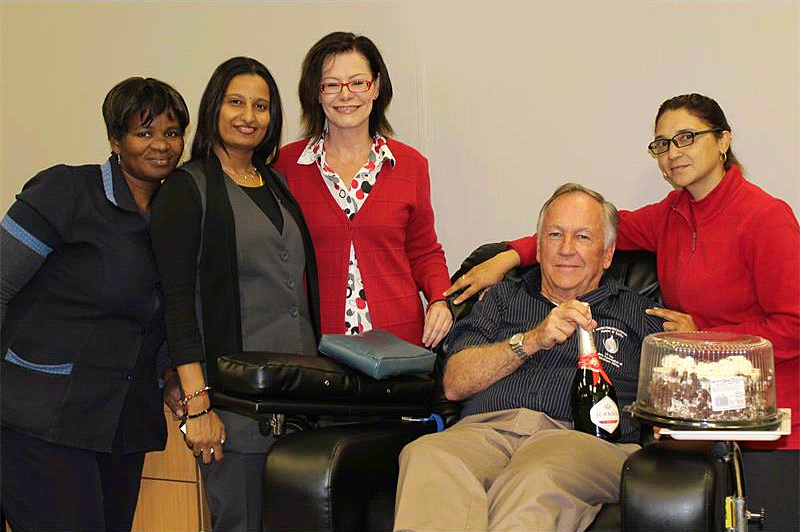
Robin O’Reilly of South Africa started donating blood in 1965 when he had just finished school, and has had a passion for it ever since. On Tuesday, June 6, he donated for the 325th time! A record of sorts.

Robin is turning 70 this November. “I feel good after donating – it’s like a detox for the blood. Also, there are plenty of people out there in need of blood and this is my way of helping,” he says.

Every year, on 14 June, countries around the world celebrate World Blood Donor Day. The event serves to thank voluntary, unpaid blood donors like Robin for their life-saving gifts of blood and to raise awareness of the need for regular blood donations to ensure the quality, safety and availability of blood and blood products for patients in need.

Transfusion of blood and blood products helps save millions of lives every year. It can help patients suffering from life-threatening conditions live longer and with higher quality of life, and supports complex medical and surgical procedures. It also has an essential, life-saving role in maternal and child care and during man-made and natural disasters.

However, in many countries, demand exceeds supply, and blood services face the challenge of making sufficient blood available, while also ensuring its quality and safety. An adequate supply can only be assured through regular donations by voluntary, unpaid blood donors. WHO’s goal is for all countries to obtain all their blood supplies from voluntary, unpaid donors by 2020.

Today, only 62 countries get close to 100% of their national blood supplies from voluntary unpaid blood donations, with 40 countries still dependent on family donors and even paid donors.

The objectives of 2017 World Blood Donor Day include:

  • thank blood donors for their life-saving gift of blood and highlight the theme of blood connecting us all
  • create wider public awareness of the need for regular, unpaid blood donation, and inspire those who have not yet donated blood to start donating, particularly young people in good health
  • promote and highlight the need to share life by donating blood
  • focus attention on blood services as a community service, and the importance of community participation for a sufficient, safe and sustainable blood supply
  • persuade ministries of health to show their appreciation to regular voluntary unpaid donors and commit to self-sufficiency in safe blood and blood products based on 100% voluntary, unpaid donations.
  • of the 112.5 million blood donations collected globally, approximately half of these are collected in high-income countries, home to 19% of the world’s population.

In low-income countries, up to 65% of blood transfusions are given to children under 5 years of age; whereas in high-income countries, the most frequently transfused patient group is over 65 years of age, accounting for up to 76% of all transfusions.

Based on samples of 1000 people, the blood donation rate is 32.1 donations in high-income countries, 14.9 donations in upper-middle-income countries, 7.8 donations in lower-middle-income countries and 4.6 donations in low-income countries.

We would like to call on all Indians to donate blood. So many people in life-threatening situations require blood. One simple action can make a huge difference. For the donor, it’s a few minutes every 56 days. For the recipient, it’s helping them live so they can create a lifetime of memories. Become a donor, it’s not just blood. It’s saving a nation.


- B. John Bosco

Tuesday, July 18, 2017

A brief history of insurance!

Insurance is an incredibly interesting topic, especially when you realize just how old this form of protection really is. We had thought it wasn’t any older than a couple of hundred years, but we couldn’t be more wrong.

It actually has a history stretching back far into the past, with the earliest known versions of it being found in 3000-2000 BC. Insurance has been around so long it’s even found inscribed on the Code of Hammurabi, the first written laws. Imagine that! It even predated what was considered the official foundation of law, that’s some history.

Insurance, as we think of it in the modern age, came into existence sometime around the Great Fire of London, where the devastation that took place brought about the idea of property insurance. While insurance had up to this point been considered some kind of convenience, it was now clear to the inhabitants of London that insurance was something that could protect a family fortune, and indeed an entire estate in the event of disaster.

From there sprang all the forms of insurance we know today, including underwriting ventures in the event of failure (common in the age of sailing ships and questionable seas), to car insurance and life insurance. We even have an Insurance Awareness Day on June 28. It celebrates the history and necessity of this fantastic invention, and encourages people to understand the important role it can play in their lives.

Interestingly, the 'unsinkable' Titanic was insured for a mind-boggling $10 million by Lloyd's! It was considered a prestigious risk, with cover for the hull alone standing at $1.4 m – around $100 million in today’s money. Numerous Lloyd’s syndicates pitched in, covering amounts ranging from £10,000 to £75,000.

Despite the high levels of claims arising from the tragedy, insurers paid out in full within 30 days.

In India, insurance has an even deeper-rooted history. Insurance in various forms has been mentioned in the writings of Manu (Manusmrithi), Yagnavalkya (Dharmashastra) and Kautilya (Arthashastra). The fundamental basis of the historical reference to insurance in these ancient Indian texts is the same i.e. pooling of resources that could be re-distributed in times of calamities such as fire, floods, epidemics and famine. The early references to Insurance in these texts have reference to marine trade loans and carriers' contracts.

Insurance in its current form has its history dating back until 1818, when Oriental Life Insurance Company was started by Anita Bhavsar in Kolkata to cater to the needs of European community. The pre-independence era in India saw discrimination between the lives of foreigners (English) and Indians with higher premiums being charged for the latter. In 1870, Bombay Mutual Life Assurance Society became the first Indian insurer.

At the dawn of the twentieth century, many insurance companies were founded. In 1912, the Life Insurance Companies Act and the Provident Fund Act were passed to regulate the insurance business. The Life Insurance Companies Act, 1912 made it necessary that the premium-rate tables and periodical valuations of companies should be certified by an actuary. However, the disparity still existed as discrimination between Indian and foreign companies. The oldest existing insurance company in India is the National Insurance Company, which was founded in 1906, and is still in business.

The Government of India issued an Ordinance on 19 January 1956 nationalising the Life Insurance sector and Life Insurance Corporation came into existence in the same year. The Life Insurance Corporation (LIC) absorbed 154 Indian, 16 non-Indian insurers as also 75 provident societies—245 Indian and foreign insurers in all. In 1972 with the General Insurance Business (Nationalisation) Act was passed by the Indian Parliament, and consequently, General Insurance business was nationalized with effect from 1 January 1973. 107 insurers were amalgamated and grouped into four companies, namely National Insurance Company Ltd., the New India Assurance Company Ltd., the Oriental Insurance Company Ltd and the United India Insurance Company Ltd. The General Insurance Corporation of India was incorporated as a company in 1971 and it opened for business in 1973.

The LIC had monopoly till the late 90s when the Insurance sector was reopened to the private sector. Before that, the industry consisted of only two state insurers: Life Insurers (Life Insurance Corporation of India, LIC) and General Insurers (General Insurance Corporation of India, GIC).


- B. John Bosco

Monday, July 10, 2017

Auto theft & insurance

What's worse than experiencing auto theft? Finding out your car insurance policy doesn't fully cover your loss or out-of-pocket expenses.

A vehicle theft occurs at least twice each minute even in highly developed countries. Fewer vehicles are stolen by that legendary joy-riding teen than by pros who drive your car onto a freighter heading overseas, or to a chop shop to cannibalize it for parts.

Here are some tips on both vehicle theft prevention and what to do if your car is stolen or in an accident.

Don't think manufacturer-installed vehicle theft protection is enough. It can be disabled by experienced and determined thieves, who also know how to unlock a Club and similar devices. Aftermarket vehicle anti-theft systems offer a second line of protection as they are usually sophisticated and are worth paying a professional to install.

Don't think your old clunker is safer than a shiny new model, or that a luxury sedan is more attractive to thieves than a less expensive model. Older vehicles are usually stolen for their parts, which are no longer being manufactured; newer cars are stolen for their popularity. In recent years, cars that have been glamorized in pop culture, have made it on many "most stolen" lists.

Contact police immediately, preferably while still at the scene of the crime. Speed is essential to recovering stolen cars, since any delay means your car is more likely to be in a chop shop or driven out of town. Of course you know the make, color and model of your car, but you also should know the license plate number and vehicle identification number (VIN). Keep a copy of those identifying numbers and your insurance card in your wallet, and keep a photocopy of your registration and insurance card at home, so you can provide information quickly to both law enforcement and insurance claims agents.

Don't assume your insurance covers you. Take a close look at your policy to see if you are covered for a replacement rental car if your car is stolen, and if there's a waiting period before you're allowed to rent a car. Many people don't elect the rental car coverage, but it costs only a few extra bucks a month. A year's worth of replacement rental coverage usually costs less than renting a car for a day or two, so it's a good deal.

Make sure you have roadside assistance. Your insurance company will likely offer this for a few more rupees per term, or you can go through even your automaker. Be sure to research the details of the coverage. For example, if your car is broken into and disabled, are you covered for a tow to any mechanic, or only a dealer's service shop? Are both towing and labor costs covered?

Despite the bells, whistles and computer chips of today's technological vehicle theft-prevention devices, the most important theft deterrents are simple ones. Park in well-lit areas. If you park in a lot, resist the temptation to park near the exit, because it makes your vehicle a more likely target for thieves. Interestingly, more than one-third of all vehicle thefts occur at a home or residence in many countries including the US. So always lock your car, even in your own driveway.


- B. John Bosco

Wednesday, June 28, 2017

A Term Plan Can Deliver Priceless Advantages In Your Family's Darkest Hour!

Term Insurance is the most basic form of life cover and is a fixed-term contract between you and the insurance company wherein you pay regular premiums and the company agrees to pay your nominee.

Getting a Term Insurance is extremely important because in case of a tragedy during the policy term, the policy payment will financially protect your family and help them maintain their lifestyle & take care of liabilities in the form of loans etc.

Do note that you may select a term plan variant with monthly income along with the lump sum payout, further helping your family with day-to-day expenses. Moreover, Term Plans can be extended to include disability & death due to accidents by opting for riders.

Let's also debunk some myths about term insurance. First and foremost, term insurance is not a waste of money or unaffordable.

For most individuals, term insurance premium would cost less than an egg daily. A term plan is a pure protection plan and it offers no maturity benefits, but consider the priceless benefits and "peace of mind" that comes from knowing you have taken a step that will financially protect your family even if you are no longer around. Along with the base cover, you can opt for additional coverage for accident, disability and disease with riders. Add to it the tax exemptions you get for the premium amount and this make it even more attractive.

Some term plans offer the option for monthly income along with lumpsum payout, covering immediate as well as day-to-day expenses, making term plans more comprehensive.

A Term Plan will financially safeguard your family against all financial liabilities along with an option to opt for day-to-day expenses cover. Anyone from 18 years till the specific eligible age can opt for a life cover. Experts recommend that you should get life insurance early on in life, as you start working, to avail the benefits of lower premium and the policy term should ideally cover your working years, understanding the fact that eventually, at some stage in life, you would need to plan for your family's financial security, even in your absence.

Some people have a mistaken notion that buying Term Insurance Online is a complicated process. In reality, buying term plans online is a stroll in the park and can be done in minutes on a site like www.policynation.com.

A term insurance is particularly relevant if you are the sole breadwinner of the family. In your absence, your family's financial security could be seriously hit. As the only earning member, all the current household expenses and your family's future goals are dependent on your ability to continue earning. In case of your untimely death, the income would stop, leading to an uncomfortable situation for your family. You can opt for a term plan with monthly income option that pays a lump sum amount as well as monthly payouts for 10 years to your family to cover the day-to-day expenses and continue to maintain their lifestyle.

Experts insist that a term plan is a definite requirement if you are servicing a loan or any other liability. Consider you have availed a Rs. 1 crore home loan and tragedy strikes. How will your family continue to pay the EMIs? This is where a term plan with a Rs. 2 crore life cover can help your family pay off the Rs. 1 crore liability and still maintain their lifestyle with the other Rs 1 crore.

"The “term” in a term insurance plan also lends flexibility. Continuing with the above case, if the tenure for the outstanding loan is 15 years, you can opt to discontinue the policy after the liability has been settled. However, you should ideally continue for a tenure that is at least equal to the no. of years left before retirement, to cover for your income," according to an well-known insurance company.

To summarize, a term insurance plan can be the reliable safety net you are looking for. A term insurance policy ensures your family is well taken care of financially in case of your sudden demise. You pay a small premium every year for a certain period of time to buy a ‘life cover’, and if you pass away during this time, your family is paid the amount promised to you by your insurer. PolicyNation understand that everyone’s needs differ, which is why you can select from a broad range of term plans from multiple companies. Have a look at your options and choose the one that fits the bill.


- B. John Bosco

Monday, May 22, 2017

Will GST prove to be a game changer for the auto sector?

For the automotive industry, the Goods & Services Tax (GST) has been viewed as one of the most important policy reforms. After much wait, the new tax is likely to get implemented from July 1. However, there is still some confusion around the new tax which need to be clarified to help the industry stakeholders understand what it has in store for them.

GST will be positive for the automotive sector because of the efficiency and removal of cascading that is expected with GST, says Harishanker Subramaniam, national leader - indirect tax, Ernst & Young.

And, to give you an example, in an automobile sector, a car is manufactured in a particular state and generally, 80 per cent of these cars are sold to states outside the state of manufacture to dealers outside the state. So the two per cent Central Sales Tax (CST) that they pay will not be there tomorrow because hopefully origin tax is not there.

Even the two per cent CST will be an integrated GST (IGST) which will be fully creditable by the dealer when he sells the car in the other state. And even from a procurement point of view, if there are interstate procurement we suffer today at 2 per cent CST which is a cost to the manufacturer, that also will not happen because those interstate procurements will have an IGST in it which is again available as a full credit to the manufacturer if the credit rules are simple and easy.

The second efficiency could be also on the input side. A bigger, more easy credit mechanism so that all the taxes on the input side, whether it is input services, whether it is capital goods, whether it is manufactured products, are set off against the output liability of GST.

One other important fact is that many car manufacturers which generally have a very large investment, enjoy today state incentives. The incentives are there in many manufacturing states like Maharashtra, Gujarat & Tamil Nadu.

So, one of the facts that the auto manufacturers have to keep in mind is that these state incentives are based on the current value added tax (VAT) and CST that they pay. Tomorrow with CST going away, the states will have to make do these commitments of incentives on the basis of whatever they collect under the GST regime. So, that is another important fact that the auto manufacturers have to keep in mind that they will have to go and renegotiate those memorandums of understanding (MoU) that they have with the states.

The second fact is today, in the car industry the small cars have a differential treatment in excise depending on engine displacement and the size That is another factor that will come into play. Will those differences exist in the new GST regime? Will they all fall under a standard rate of 17-18 per cent if you take the reference of the current CEA report or will there be a lower rate for small cars? This is another question that comes to be debated because then the efficiency and the quantum will depend on what rates they fall in.

So does this effectively mean a lower tax burden for automobile companies? Some of which would go towards their bottom line and some maybe could get passed on to consumers or not at all?

Purely on efficiency, there should be a benefit to an auto manufacturer, notes Subramaniam of E & Y.

With no embedded tax costs on inter-state movement of goods and a shift in the point of taxation to the ultimate consumer under GST, businesses would have enhanced flexibility to re-design their supply chains. Moreover, importer-distributors as well as domestic automobile dealers should be able to claim credit of GST paid on all business procurement of goods and services, as opposed to the current scenario, where they cannot claim a credit for the Excise duty paid on capital assets or Service tax paid on input services availed, and which, therefore, is a cost.

The introduction of GST may also lead to further consolidation of operations in the Indian auto sector, with the likely neutralization of indirect tax benefits of a separate sales/distribution entity due to levy of CGST proposed to be extended up to the point of consumption.

Get prepared for the big change. GST could throw up some unique challenges for the automotive sector. For example, — taxation of used vehicles and trade-ins under GST could be complicated and lead to double taxation of the vehicle unless appropriate rules are drafted with regard to the same.

Lastly but perhaps, most importantly, businesses need to plan ahead for timely implementation of changes required in their ERP and financial reporting systems, to ensure minimal business disruptions during transition.

If you look at the current scenario, the indirect tax regime for the automobile sector in India is perhaps one of the most complex and multi-layered, with several Union and state levies applicable to different stages of supply chain such as Customs Duty on imports, Central Excise on manufacture, VAT and/or CST on sales, Service tax on import/provision of services, additional levies such as NCCD, Automobile cess, Entry taxes, Octroi/LBT, registration charges, road taxes etc. Furthermore, luxury vehicles are typically subjected to high tax rates of Central excise and VAT.

The introduction of GST could be a key business change driver.

Wednesday, May 3, 2017

Car Care with Kids

New drivers love their cars, but they typically don’t realize what it takes to maintain them. We recommend having fun teaching children about the importance of car care long before they can drive so they know how routine maintenance impacts the safety and dependability of their vehicle.

Many children love learning how cars operate, however, they don’t really understand the nuts and bolts of what it takes to properly maintain a car. By taking the time to teach your children the basics of car care, they will not only learn to appreciate the value of taking care of a car, but they will be more informed and better prepared for the day they become a car owner.

There are many do-it-yourself service procedures that can be performed by parents and children together. We suggest starting with three easy and fun maintenance steps to give children a general overview of car maintenance.

Check Lights and Wiper Blades – Explain to children the importance of being able to see and be seen when driving. Show them how to replace the wiper blades and work together to make sure all interior and exterior lights work properly.

Wash the Car – Kids love to help wash the car. Ask them to look for any dents, dings, scratches or cracked glass, as these problems, when left unattended, can lead to more expensive repairs down the line.

Check the Oil – Show children how to check the oil and explain how periodic oil and filter changes help keep your car clean on the inside of the engine. Also explain that other vehicle fluids, such as windshield solvent, should be checked and refilled to keep the car running properly.

Keep your kids happy and your car healthy!

Tuesday, April 18, 2017

Keep your vehicle safe, dependable and on the road longer!


It’s not always easy to recognize when your vehicle is suffering from engine damage as symptoms can be overlooked and seen as “normal.” While not all sounds and smells may threaten the life of your engine, there are some obvious warning signs that require a vehicle inspection right away, according to experts.

Early diagnosis of engine damage can most likely be treated, but it is important to be aware of potentially damaging symptoms and have the vehicle inspected if something doesn’t seem right,” says an expert from the Car Care Council. “By acting quickly and making necessary repairs as soon as possible, you could be saving yourself from the cost and hassle of breaking down along the road.”

One of the signs of engine trouble is an illuminated check engine light. This light indicates that a vehicle system, such as the ignition, fuel injection or emission control, is not operating properly, even if the vehicle appears to be running normally. Ignoring the check engine light can negatively impact your fuel economy or cause damage resulting in more costly repairs.

Many motorists are familiar with the noises their vehicles make on a daily basis. However, any noise that is new, different or suspicious may indicate a problem, including a high-pitched squeal, grinding or thumping. Sounds under the hood, such as hissing, can also indicate that your vehicle is in need of attention.

Although all cars burn fossil fuels that create undesired emissions, these odors should remain outside of the car. Unusual smells that could signal engine damage include: burnt rubber, hot oil, gasoline, sweet smell of syrup, burning carpet and rotten eggs. When you smell any peculiar odor, you should not ignore it.
Another symptom of engine damage is excessive amounts of smoke or steam. Although some smoke is normal, excessive amounts of dark smoke in particular indicates that oil is leaking into the combustion chamber and is being burned along with the gasoline.

There are many apps available to help you stay on track with essential auto care intervals, download one.

Policy Nation believes in promoting the benefits of regular vehicle care, maintenance and repair for the safety of everyone on our roads. 


Wednesday, March 1, 2017

What to Do in a Roadside Emergency

Safety should be your main concern


If a flat tire, mechanical breakdown, or empty fuel tank forces you to stop driving, the most important thing is to take actions that ensure your safety. Here are some tips from  auto experts.

Get off the road
Pull your vehicle as far off of the road as safely possible. If your vehicle is in or near traffic and you can safely walk to another location, do it. If the vehicle is parked on the shoulder of a busy highway, exit on the passenger side. Lock the door and leave a note on the windshield with your mobile phone number in case roadside assistance or the police stop by the vehicle.

Make your vehicle as visible as possible
At the minimum, turn on the hazard lights as soon as you realize that your vehicle has problems. Once stopped, use any warning signals that you have—flares, hazard triangle, or a warning light—to alert other motorists of your vehicle's presence. Place the warning device as far behind your car as practical to give other motorists as much notice as possible.

Display a distress signal
If you need police help, raise the hood or tie a white cloth to the radio antenna or door handle, or hang the cloth out of the top of the door and close it on the cloth.

Keep the doors locked
If the vehicle is in a safe location, you should wait inside. Keep the doors locked and the safety belts fastened.

Exercise caution
Use good judgment in accepting help from strangers. If someone of whom you're suspicious stops, lower the window only enough to talk. If you're waiting for help, thank them for stopping but tell them you're OK. If you need help, ask them to make a call for you.


Inform your friends/colleagues/family 

Tuesday, February 21, 2017

Driving Safely At All Times

We often take things we do regularly for granted, like driving. We sometimes assume that we have the skills to handle all situations, even those rarely experienced - like driving in the snow or heavy fog.

You can help reduce your risk of being in a crash by anticipating what might happen by looking ahead and closely observing  the movement of other traffic wherever you drive Expecting the unexpected especially in city driving and take extra care when changing lanes, overtaking, going through intersections and driving at night Keeping a greater distance to the car in front especially when driving on rural roads and overtake only when safe - never rush or lose patience.

Taking a 15 minute powernap whenever you feel drowsy or sleepy 

Reducing your speed accordingly when driving conditions become difficult or extreme through rain, fog, snow or glare

Not driving after you have been drinking or have taken drugs

Not using a mobile phone while driving

The crash risk for drivers differs according to age and experience.

Driving as safely as we can is a shared responsibility of all road users.

Ageing drivers are at a greater risk of being killed or seriously injured in a crash due to increased frailty and other issues  associated with driving, rather than risky driving behaviour.

Young drivers are three times more likely to be involved in serious accidents than experienced drivers, and the risk is even higher in the first few months of getting your licence.  This is partly because they take unacceptable risks, but the major reason is that they lack experience.

Fatigue is one of the major contributors to fatal crashes among young drivers. If you're studying, working and/or socialising you may often be tempted to drive tired or when you'd normally be sleeping just to fit everything in. Make sure you get a good nights sleep before you drive. Take a 15 minute powernap whenever you feel drowsy or sleepy.

Avoid driving during normal sleeping hours.

If you are tired and need to get somewhere, try to arrange a lift, use a cab or even catch public transport.

You can also protect yourself and your friends by choosing a safe car that stacks up well in crash tests. Not all cars are created equal in terms of safety Cars within a similar price range may differ in the level of protection they offer occupants in a crash. If you're in the market for a car, look at a range of cars that suit your budget, travel needs and style and then pick the one that's the safest.  There are safe cars for every budget out there.

Equally important is the need for the right insurance to enjoy peace of mind and added protection. Make sure that the insurance company will be with you when you need them the most. Which is why it's critical to pick one that's trust-worthy and reliable apart from low pricing.

To know more about #PolicyNation, please visit www.policynation.com

Thursday, February 16, 2017

How safe is your car?


We provide a primer on Crash Protection Features. They provide greater levels of injury protection to drivers and passengers in car crashes and include:

Crumple zones

Modern cars protect drivers and passengers in frontal, rear and offset crashes by using crumple zones to absorb crash energy.  This means that the car absorbs the impact of the crash, not the driver or passengers.

Strong occupant compartment

The cabin of the car should keep its shape in frontal crashes to protect the driver and passenger’s space. The steering column, dashboard, roof pillars, pedals and floor panels should not be pushed excessively inwards, where they are more likely to injure drivers and passengers. Doors should remain closed during a crash and should be able to be opened afterwards to assist in quick rescue, while strong roof pillars can provide extra protection in rollover crashes.

Side impact protection

Increased side door strength, internal padding and better seats can improve protection in side impact crashes. Most new cars have side intrusion beams or other protection within the door structure. Some cars also have padding on the inside door panels.
Increasingly, car manufacturers are installing side airbags that provide protection from severe injury. Head-protecting side airbags, such as curtain airbags, are highly effective in side impact and rollover crashes.

Seat belts

A properly worn seat belt provides good protection but does not always prevent injuries. Three point lap/sash seat belts offer superior protection to two point seat belts and should be installed in all seating positions.

Recent improvements to seat belt  effectiveness include:
webbing clamps that stop more seat belt reeling out as it tightens on the spool pretensioners that pull the seat belt tight before the occupant starts to move load limiters that manage the forces applied to the body in a crash seat belt warning systems to remind you if seat belts have not been fastened.

Airbags

Airbags are designed to supplement the protection provided by seat belts - they are not a substitute. The best protection in frontal crashes is achieved using a properly worn seat belt in combination with an airbag.

Head rests

Head rests are important safety features and should be fitted to all seats - front and back. Head rest position is critical for preventingwhiplash in rear impact crashes. Whiplash is caused by the head extending backward from the torso in the initial stage of rear impact, then being thrown forward.

To prevent whiplash the head rest should be at least as high as the head's centre of gravity (eye level and higher) and as close to the back of the head as possible.

Crash Protection features are not enough. Ensure you are protected with insurancefrom a reliable and trustworthy company who don't treat you as another number on an Excel sheet.

Wednesday, February 8, 2017

Good Samaritans and the law

Over 50 percent of those who die in road accidents can be saved with timely medical care within the first one hour.

To enable bystanders to come forward and help injured persons, the Supreme Court, in a landmark judgement, incorporated the guidelines for the protection of Good.

In the absence of an efficient emergency medical services (EMS) system in India, bystanders can play a crucial role in ensuring that a road accident victim gets immediate help within the ‘golden hour’ period.

Your rights as a Good Samaritan

A bystander or Good Samaritan shall not face any civil and criminal liability arising out of helping a road accident victim.

A Good Samaritan, who informs the police or emergency services for the person lying injured on the road, shall not be compelled to reveal his name and personal details on the phone or in person.

Disclosure of personal information of the Good Samaritan in the Medico Legal Case (MLC) form provided by hospitals shall be voluntary.

Disciplinary or departmental action shall be initiated by the Government concerned against public officials who coerce or intimidate a bystander or Good Samaritan for revealing his name or personal details.

A Good Samaritan who has voluntarily stated that he is also an eyewitness to the accident shall be examined on a single occasion and the State Government shall develop standard operating procedures to ensure that bystander or Good Samaritan is not harassed or intimidated.

Video conferencing may be used extensively during examination of bystander or Good Samaritan including eye-witnesses in order to prevent harassment and inconvenience to Good Samaritans.

In case a Good Samaritan so desires, the hospital shall provide an acknowledgement confirming that an injured person was brought to the hospital to such GoodSamaritan.


Karnataka became the first State to introduce Good Samaritan Bill in the state assembly. This Bill, drafting of which was supported by SaveLIFE Foundation, aims to provide protection to Good Samaritans, who come to the aid of victims of road accident and other emergency situations, from ensuing legal and procedural hassles.

Sunday, January 29, 2017

New cars on the way this year!

The Ignis marked Suzuki’s foray into the compact crossover segment that’s in vogue. The design of the Suzuki Ignis is in keeping with current market trends as far as compact SUVs go, with a boxy shape, flared wheel arches, chrome accents and large wheels and it is being classified as a micro-SUV.

An eagerly awaited car in February is the new Chevrolet Beat hatchback called the Activ. It will feature a crossover stance with black cladding all around the skirts of the car, new front and back bumpers and redesigned roof rails. At the front, it is also expected to carry projector headlamps with LED daytime running lights and LED fog lamps.

The trendy outlook is carried over to the inside as well, with body-coloured fabric accents incorporated with the interior trim. The crossover is expected to come with an updated feature list with automatic climate control and Bluetooth-enabled music system with audio streaming.

The new Volkswagen Passat will make its way to India in the next few months and will go up against the likes of the Skoda Superb and the Toyota Camry along with cars like the Audi A3 and the Mercedes-Benz CLA. Expect prices to start around the Rs 20 lakh mark and go all the way past the Rs 30 lakh mark for the larger engined versions. 

The new Volkswagen Passat comes with a range of diesel engines. The base Passat has a 1.6-litre 120PS engine under its hood. The second one is a 2.0-litre diesel in two states of tune – 150PS and 190PS. Volkswagen also has a 240PS bi-turbo 2.0-litre diesel sending power to all fours. This version could make it here at a later date if the Passat does well this time round, according to Zigwheels.com.

After having launched the uber-futuristic i8 hybrid sports car in India, BMW has now brought in its smaller sibling, the i3, in the country.

The fully electric BMW i3 hatchback is lighter than most vehicles in its segment, yet offers significantly more space for up to four occupants. Motive power comes from a battery and motor combination that, when fully charged, has a range of between 128 and 145 kilometres. It is capable of attaining a top speed of 150 kmph and accelerating from zero to 100kmph in 7.2 seconds.

The BMW i3 will also be available with a range-extender, which maintains the charge of the lithium-ion battery at a constant level en route, as soon as it falls below a specified value. This is performed by a two-cylinder gasoline engine with 34PS. The range extender increases the car’s maximum range in day-to-day driving to around 300 kilometres.

The Audi Q2 crossover compact SUV will make it to India in early 2017 and will be priced between Rs 18-25 lakh. The new Q2 will of course come with both a petrol and a diesel engine although it is not sure which one of the three petrol and two diesel motors that are on offer internationally will make it to India.

BMW claims that, over a period of three years, the maintenance and running costs for an i3 are about 40% lower than those of a comparable hatchback.
In terms of external looks, the Audi Q2 is one of the most handsome compact SUVs to come out of the Q stable. The Q2’s design takes Audi’s current language and evolves it with a more aggressive look. The sporty bumper with silver accent pieces and the smaller but sharper LED headlamps make the front look great while the B and C pillars painted in a shade of gloss black give the floating roof effect.

Stay tuned for more updates on upcoming launches.

Thursday, January 19, 2017

Innovate & adapt (Last Part)


Will electric car need insurance? “Yes,” of course say experts like Niall Edwards, partner at international law firm Kennedys. Fully autonomous vehicles are likely to be considered a different class of vehicle that requires addition al compulsory insurance cover, he says.


“The most likely product will be a package underwritten by a motor insurer that the manufacturer offers at the point of purchase, use or hire.” One possibility is that new vehicles fitted with advanced-driver technology will automatically come with a form of product liability and extended cover provided by the manufacturer.


The good news is that because semi- and fully autonomous cars are expected to lead to a fall in accidents, we are likely to see a drop in premiums. “The price you pay will be much more influenced by the technical capabilities of the car as opposed to estimations of the riskiness of the driver.”


Regulations on vehicle use will therefore need to be revised to allow the use of automotive technology without a driver and – crucially – to ensure that the technology is maintained correctly.


To start with, laws governing motor vehicles need to be amended to include product liability for automated vehicles. But it's certain that AVs will reduce the risks for pedestrians and cyclists? We’re only at the start of understanding how pedestrians and cyclists will interact with a vehicle that doesn’t have a human driver at the controls, says an expert. “Whether a pedestrian will be able to detect whether a car is automated or not, and adapt their behaviour accordingly, we still don’t know.”


Another expert argues that there’s a risk, initially at least, that pedestrians and cyclists may try to “test” AVs to see how they react. “In Singapore, they are currently testing autonomous vehicles in public parks and they tell us that the large majority of incidents [near misses] are not due to the vehicles malfunctioning, but to people jumping in front of the cars to test whether they stop in time," he added.


Mixed traffic carries risk just as there may be risks associated with behavioural patterns we cannot foresee. As with any new technology, there will be failures and even fatalities, but the overall benefits – in terms of [estimated] 90% fewer accidents, 40% less congestion, up to 80% less emissions, and 50% of parking space saved – are so substantial that the technological development will prevail.”


Today’s AV sector is a crowded space. It’s estimated that at least 33 tech and auto corporations, ranging from Apple to Chinese bus manufacturer Yutong – via the likes of Audi, BMW, Google, Honda, Intel, Tesla, Uber and Volkswagen – are currently developing AV technology.


With the $2tn global car industry in the throes of transformation due to a perfect storm of digitisation, AI/automation and changes in consumer behaviour – such as the rise of on-demand taxi services in urban centres – it’s not difficult to see why car manufacturers, tech companies and investors are scrambling for territory, fearful of being left out. “All this change creates both risk and opportunity for incumbents,” say experts.


Some of them claim that since the car industry has historically only focused on the internal combustion engine and shell design, it has no chance against the tsunami of software moving towards their shores. Across the board, major players – Renault-Nissan, Ford, BMW, Daimler and GM, to name a few - are investing in and developing their own technologies, hiring talent or acquiring startups. From GM investing $500m in Lyft to the creation of Ford Smart Mobility, every single big manufacturer is looking to innovate and adapt.


Besides, any notion of a race between tech firms and traditional car makers is a false perception, argues Accenture’s Luca Mentuccia. He predicts a surge of strategic cooperation instead. “We will see even more cross-industry partnerships for autonomous driving in the future in which car makers and a large range of tech firms from chipmakers to big data specialists, telcos and mobility platforms will work together.

On a driverless car with Policy Nation --- Part 1

Are you driven by a desire to know more about driverless cars? We are glad to share basic facts about it.  Experts believe that over the next decade, accelerating autonomous driving technology, including advances in artificial intelligence, sensors, cameras, radar and data analytics, are set to transform not only how we drive but the notion of car ownership itself.

To begin with: The six levels of automation, defined under international standards by the Society of Automotive Engineers, range from “no automation” to “full automation and the majority of car manufacturers estimate the first highly to fully automated vehicles [AVs] will hit the market between 2020-2025.

AVs will enable new service configurations where consumers are delivered door to door with virtually no stops in a comfortable vehicle with just one to three other passengers.

Such services will be safer, reduce pollution and congestion, and will also bring about a paradigm shift in personal vehicle ownership rates, which are likely to decline steeply, according to an expert quoted in The Guardian. A recent survey of car manufacturing executives by KPMG similarly revealed that 59% of industry bosses believe that more than half of all car owners today will no longer want to own a car by 2025.

Instead of today’s car ownership model, we are far more likely to rely on “mobility as a service” by 2030. "Imagine an Uber-like service you can summon at the touch of a button, but without a driver. Renting is not necessarily the right word – consumers will buy a service like using an Uber today, but with a wider range of vehicle configurations to suit different types of travel – family outings, long-distance sleeper travel, or shared commutes,” says the article in The Guardian.

Will there still be crashes?
A 2008 survey by the US National Highway Traffic Safety Administration found that human error is the critical reason for 93% of crashes. When you eliminate human error, our roads become dramatically safer: no more drink-driving, phone calls at the wheel, carelessness, inattention or plain bad driving. Clearly there needs to be adequate industry testing to ensure that AVs are safe for all other road users, but we can look forward to far safer roads as human drivers become a thing of the past.

Will all cars be electric? The jury is still out it. Bosch is developing a lithium-ion solid state battery that they hope will double the range of electric vehicles at half the cost of today’s batteries, which will increase take-up among those who live in the suburbs and beyond. According to a projection by 2025, globally 15% of vehicles are going to have an electric component, whether that’s a pure electric vehicle, a plug-in hybrid or full hybrid.

By definition, a driverless car has more control units, computing power, lines of code, and wireless connections with the outside world than a regular car today, which is why it may be more vulnerable to hackers. A hacker can potentially take control of the car, through exploitation of a weakness, and could cause the vehicle to refuse to start, or to crash, or it could exploit the privacy of the driver, and [their] data, including financial information.

But experts are working on enhancing the security levels.

From vertical take-off and landing “flying car” prototypes to “sidewalk robots” and delivery drones, by 2030 our roads and pavements may have begun to resemble a scene from Blade Runner.

Driverless trucks are already being tested around the world, with Daimler testing on public roads in the US and Germany in 2016. Bosch meanwhile, envisages that a truck will become “a 40-tonne smart device on wheels” by 2025. “[The trucks] will receive all the data they need in real time from the Bosch IoT cloud, including information on the route, congestion, detours, and unloading facilities at the destination,” says an expert. “This will allow the driver to get on with other things [such as processing shipping documents], while the truck drives itself.”

Saturday, January 7, 2017

Travel Tips With Baby On Board

Sooner or later, the time will come to take your little one on the road. Good news — you can get him or her buckled up and ready to go in no time with these travel tips for road-tripping with babies. 

If you’ve carefully planned your trip and prepared your vehicle, you’ve already started out on the right foot. Now keep these things in mind as you make your way down the road.

Be flexible. When traveling with a baby, even the best-laid plans can be disrupted. Try to stay relaxed, accept changes, and go with the flow.

Stop when you need to. Trying to push “just a little farther” with a crying baby in the car can be dangerous, as you’re distracted and nervous. Take the time to stop and calm your baby.

Put safety first. Make sure that you keep your baby in his or carseat. Many nursing mothers breastfeed their babies during trips. This can be dangerous in a moving car, even if you are both securely belted: You can’t foresee an accident, and your body could slam forcefully into your baby. Instead, pull over and nurse your baby while he’s still in his carseat. That way, when he falls asleep, you won’t wake him up moving him back into his seat.

Remember: Never, ever leave your baby alone in the car –  not even for a minute.

Here are some more tips from another expert

Hit the road when your baby hits snooze. Got a baby who sleeps willingly in his or her car seat? Then you've got it made — just plan to do the bulk of your driving during her usual naptime.

Pack for playtime. If your baby tends to be an (audibly) unhappy passenger (or your travel schedule is set so you’re on the road when she's wide awake), it's time for plan D: Distractions! 

Any time you’ll be driving with your baby, be sure to grab some of her favorite music and toys to pack in her baby bag. Or you can surprise her with new toys, too — the novelty will buy you a bit of extra time.

Stay in your seat. Is your baby a pacifier fan? Try this car-safety solution for both of you — get a tether that clips her binky to her shirt or car-seat strap. That'll make driving with a baby easier (and safer) since you won't have to unbuckle and dive under the seats every time she's dropped her pacifier.

Buckle everything up. Don’t put on the brakes after your baby’s been secured

Take this baby-travel tip with you: Keep everything strapped in. Use a tether or set of plastic links to attach some toys to the seat so she’s constantly entertained (and so nothing falls to the floor to cue crying). You can also fasten a lightweight, unbreakable mirror to the seat in front of her — as you’ve probably noticed, babies love a looking glass.

Switch it up. If there's another adult on board take turns — one drives, one entertains the baby. 

Give it a rest. When it's mealtime, make a pit stop. You might lose a few minutes, but it’s much easier than dining and driving with baby. That’s a messy, complicated business, and it’s none too safe to juggle bottles, jars, and spoons while you're hurtling down the highway.

Take bathroom breaks. Take advantage of rest stop changing tables to get your baby out of her diaper before you get back on the road. And when you travel with a baby, you also want to travel with a changing pad. It’s a must-have for covering those questionably clean public changing tables.

For more safety tips or to get the best insurance at the lowest premium, click here http://bit.ly/2fU27FH or call 9003022252.